Tech Tips
Power banks with built-in cables: never carry a charging cable again
Three cables built directly into the unit. Four simultaneous outputs. 22.5W fast charging. A digital display that shows exactly what is left. Here is what that means in practice.

- Three built-in cables: USB-C (22.5W output and input), Lightning (20W), and a second USB-C (18W) are integrated directly into the power bank body. No separate cable required between the bank and your phone.
- Four simultaneous outputs: three built-in cables plus a USB-A port at 22.5W. Charge a phone, a tablet, earbuds and a second phone at the same time from one unit.
- 22.5W fast charging: charges an iPhone from 0 to 50% in approximately 25 minutes. PD + QC 3.0 compatible.
- Digital LED display: shows exact remaining battery percentage. No guesswork before you leave home.
- Available in 10,000 mAh and 20,000 mAh: both carry-on approved for flights. Choose the capacity that matches how long you are away from a socket.
A power bank with built-in cables eliminates the single biggest friction point of charging on the go: finding and carrying a cable. Most people have experienced the moment of reaching into a bag for a cable that is not there. A built-in-cable power bank removes that possibility entirely. The cable is always with the bank, always available, and always the right cable for the device in hand. This is not a minor convenience — over weeks and months of daily use, it is a material reduction in daily friction.
What cables are built into the Gibutech 22.5W power bank?
Three cables are integrated directly into the power bank housing, retractable and protected when not in use. A fourth USB-A output port handles any additional device via a standard cable:
Exhibit 1 — Built-in cable specifications
⬡ USB-C Cable 22.5W IN/OUT · iPhone 15+, Android, tablets · PD fast charge
⚡ Lightning Cable 20W OUT · iPhone 14 and earlier, AirPods · fast charge
⬡ USB-C Cable 18W OUT · second USB-C device simultaneously
◻ USB-A Port 22.5W OUT · QC 3.0 · any USB-A cable
The USB-C cable also serves as the input port for recharging the bank itself. You recharge the power bank using any USB-C to USB-C cable from a wall charger or car charger, then deploy the built-in cables when your devices need power. One less thing to carry.
How does a built-in-cable power bank change your daily carry?
Exhibit 2 — Daily bag contents: before and after
Without built-in cables
- Power bank
- USB-C to USB-C cable
- USB-C to Lightning cable
- USB-A to USB-C cable (older chargers)
- Hope all three are in the bag
- Hope none are borrowed or forgotten
With Gibutech built-in cables
- One power bank — cables included
- USB-C for any iPhone or Android phone
- Lightning for older iPhones and AirPods
- Second USB-C for a tablet or second phone
- USB-A port for everything else
Keeping cables with a power bank is the obvious solution that most people never quite manage. Separate cables slip into different bags, get borrowed, or simply get left behind. A built-in-cable power bank removes the problem architecturally: the cables are part of the device. They cannot be separated. You pick up the bank; you have the cables. Every time, without thinking about it.
What are the key specifications of the Gibutech built-in-cable power banks?
Exhibit 3 — Key specifications
22.5W Max fast charging · PD + QC 3.0 — 0 to 50% in ~25 min
4 Simultaneous outputs · 3 built-in + 1 USB-A port
100% LED digital display · Exact % remaining — no LED dots
2 Capacities · 10,000 mAh and 20,000 mAh
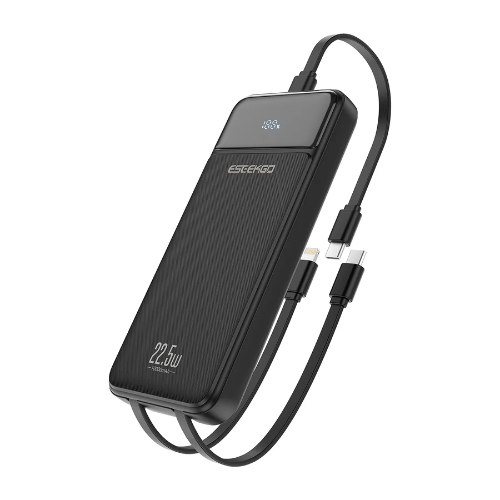
Gibutech 10,000 mAh 22.5W built-in cable power bank
3 built-in cables · USB-C 22.5W · Lightning 20W · USB-A 22.5W · Digital LED display · 37 Wh carry-on approved · ~2.5 iPhone charges
Shop the Gibutech 10,000 mAh 22.5W built-in cable power bank
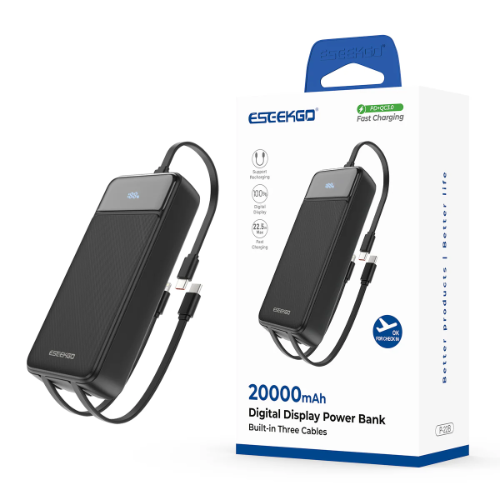
Gibutech 20,000 mAh 22.5W built-in cable power bank
3 built-in cables · USB-C 22.5W · Lightning 20W · USB-A 22.5W · Digital LED display · 74 Wh carry-on approved · ~4.5 iPhone charges
Shop the Gibutech 20,000 mAh 22.5W built-in cable power bank
Should I choose the 10,000 mAh or 20,000 mAh built-in-cable power bank?
Exhibit 4 — Capacity comparison
| Feature | 10,000 mAh | 20,000 mAh |
|---|---|---|
| iPhone 15 Pro charges | ~2.5 | ~4.5 |
| Samsung Galaxy S24 charges | ~2 | ~3.5 |
| Energy content (Wh) | ~37 Wh | ~74 Wh |
| IATA carry-on approved | Yes (below 100 Wh) | Yes (below 100 Wh) |
| Best for | Day trips, commutes, light travel | Long trips, multi-day travel, families |
Simple rule
If you are away from a socket for up to 8 hours with one phone, the 10,000 mAh is the right choice. If you travel with multiple devices, spend long days out, or take flights longer than 8 hours, the 20,000 mAh covers everything. Both fit in any pocket or hand luggage.
The last power bank you will need to pair with a separate cable
Built-in cables are not a gimmick. They solve a real problem that anyone who charges on the go faces every day. The Gibutech 22.5W LED display power banks make the solution permanent: three cables, always present, always the right connector, protected in the unit until you need them. Pick up the bank. Pick up everything else.
Frequently asked questions
What is a power bank with built-in cables?
It has the charging cables integrated into the unit — no separate cable needed. Pull out the built-in USB-C or Lightning connector and plug directly into your device. The Gibutech 10,000 mAh → and 20,000 mAh → both include three built-in cables plus a USB-A output port.
Do built-in cables wear out faster?
Not with reinforced retractable designs. The built-in cables use reinforced flex-point connectors rated for thousands of cycles. They stay protected inside the unit when not in use, preventing the everyday bag wear that damages separate cables at the connector ends.
Can I charge four devices at once?
Yes. All four outputs operate independently: USB-C built-in (22.5W), Lightning built-in (20W), second USB-C built-in (18W), and the USB-A port (22.5W). Charge a phone, a tablet, AirPods and a second phone simultaneously from one unit.
Are these power banks allowed on flights?
Yes. Both models are below the IATA 100 Wh carry-on limit: 10,000 mAh is ~37 Wh and 20,000 mAh is ~74 Wh. They must travel in hand luggage. Read the full flight-rules guide →
Which devices do the built-in cables charge?
USB-C cables charge iPhone 15+, Android phones, iPads and any USB-C device. The Lightning cable charges iPhone 14 and earlier and AirPods with Lightning cases. The USB-A port charges any device via a standard cable.
Sources and notes
- USB Implementers Forum (USB-IF). USB Power Delivery Specification Rev 3.1, 2021. 22.5W falls within PD 3.0 standard power range.
- International Air Transport Association (IATA). Dangerous Goods Regulations 2023. Lithium-ion batteries permitted in carry-on up to 100 Wh without airline approval.
- Apple Inc. "iPhone 15 Pro technical specifications." Apple Support, 2024. Battery capacity: 3,274 mAh.
- Product specifications sourced from Gibutech product pages at gibutech.co.uk as of June 2026.


