Tech Tips
Smaller, Faster, Cooler: Why You Should Switch to GaN Wall Chargers
Tired of lugging around a heavy, tangled mess of charging bricks? Ditch the charger clutter. GaN wall chargers are the compact, high-speed solution every modern traveller needs. See why you should switch to GaN wall chargers.

GaN (gallium nitride) is the most important wall charger upgrade of the decade. It delivers higher wattage in a smaller body, runs cooler under load, charges devices faster, and replaces multiple separate chargers with a single multi-port unit. The right time to switch was three years ago. The next-best time is now.
- Smaller: a 45W GaN charger has roughly the same external dimensions as the old 5W brick Apple used to include. Same pocket space, nine times the power.
- Faster: GaN charges an iPhone from 0 to 50% in 25 minutes versus 60 minutes at 5W. Roughly 2.4 times the speed of legacy chargers.
- Cooler: GaN transistors operate with 40% lower switching losses than silicon, producing less waste heat under sustained load.
- Multi-port: the Gibutech 45W GaN charger combines 2x USB-C PD and 1x USB-A QC 3.0 in one unit. Phone, tablet, and earbuds charge simultaneously from a single foldable plug.
For two decades, the trade-off was the same. A small charger meant slow charging. Fast charging meant a bulky brick that took up two plug sockets. Apple's original iPhone 5W brick fit in a pocket but took an hour to half-charge a phone. Apple's later 96W MacBook charger could fast-charge a laptop, but it weighed 300 grams and dominated a power strip. GaN technology collapses this trade-off entirely. A 45W GaN charger occupies the same physical space as the 5W brick and outputs nine times the power. The change is not marginal. It is foundational to how we now think about charging.
What is GaN and how is it different from silicon?
Every wall charger contains a switching power supply that converts mains AC electricity (240V in the UK) into the DC voltage your device needs (typically 5V, 9V, 12V, 15V, or 20V depending on charging mode). The switching is done by transistors. For decades, these transistors have been made of silicon.
GaN (gallium nitride) transistors do the same job differently. GaN is a wide-bandgap semiconductor, meaning it can switch electrical current at much higher frequencies than silicon while losing less energy as heat at each switch. The practical implications are three:
- Higher switching frequency means smaller transformers. A higher-frequency power supply uses physically smaller magnetic components, because magnetic energy storage requirements scale inversely with frequency.
- Lower switching losses mean less heat output. Less heat means smaller heatsinks and tighter component packing without thermal failure risk.
- Together, these enable significantly higher power density. The same physical volume can output significantly more power, or the same output can be packaged in a much smaller body.
Exhibit 1 — Size comparison at the same wattage class
| Legacy silicon | Modern GaN |
|---|---|
| 45W | 45W |
| Bulky brick · runs hot · single output port | Compact body · runs cool · 3 output ports |
What does the Gibutech 45W GaN wall charger deliver?
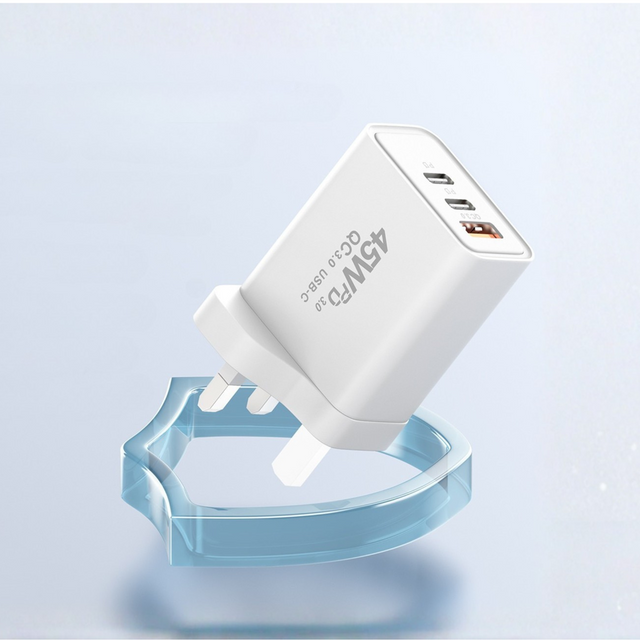
Gibutech 45W triple-port GaN wall charger
45W total · 2x USB-C PD + 1x USB-A QC 3.0 · GaN transistors · Foldable UK plug · Universal voltage 100–240V · Overcharge, overheat, short-circuit protection
Shop the Gibutech 45W triple-port GaN wall charger
Exhibit 2 — Charging speed comparison (iPhone 15 Pro, 0 to 50%)
60 min 5W brick · The old standard Apple no longer includes
30 min 20W charger · Apple's current recommendation for iPhone
25 min 45W GaN · Gibutech 45W triple-port — full iPhone PD speed
3 ports Devices simultaneously · Phone + tablet + earbuds from one unit
Which devices does a 45W GaN charger work with?
The Gibutech 45W GaN charger uses USB-C Power Delivery on its two USB-C ports and Quick Charge 3.0 on its USB-A port. This covers virtually every mainstream device released in the past five years:
iPhone 12 to 17 USB-C PD · up to 27W
Samsung Galaxy S22 to S25 USB-C PD · up to 45W
Google Pixel 7+ USB-C PD · up to 30W
iPad Air / Pro USB-C PD · up to 30W
MacBook Air M2/M3 USB-C PD · full speed
MacBook Pro 13" USB-C PD · near-full
Chromebook (USB-C) USB-C PD · 45W class
AirPods (3rd gen+) USB-C · 5W
Nintendo Switch USB-C PD · 18W
Smart power distribution
The charger's internal controller automatically negotiates the optimal voltage and current with each connected device. Plug in an iPhone and it receives 20W. Plug in a Galaxy S24 and it receives 45W. Plug in both simultaneously and the charger splits the available power intelligently — typically 25W + 18W or similar — without forcing manual configuration.
What changes when you switch to a GaN charger?
1. One charger replaces three. A 45W GaN multi-port unit replaces a separate phone charger, tablet charger, and earbuds charger. Bedside table cable management resolves itself.
2. Phones charge while you get ready. 25 minutes from 0 to 50% means a fast morning charge is a real option. Plug in during the shower and leave with a usable battery.
3. Travel kit halves in size. Where a laptop charger, phone charger, and tablet charger used to require three plug spots in a hotel room, one Gibutech 45W GaN covers all three from a single socket.
4. Cooler operation extends device battery health. Heat is the single biggest enemy of lithium-ion battery longevity. A cooler-running charger reduces the thermal stress imparted to the device during charging.
5. Future devices already work with it. USB-C PD is now the standard across iPhones, Androids, tablets, and laptops. A GaN PD charger purchased today serves the next generation of devices without replacement.
The right charger is the one you stop thinking about. GaN is the technology that finally makes that possible.
Switch once, and stop thinking about it
The 5W brick that came in the box was a compromise born of silicon's limits. GaN removes those limits. A single Gibutech 45W triple-port GaN charger covers a phone, a tablet, and a pair of earbuds simultaneously, in a body the size of the original 5W brick, at 2.4 times the speed, with built-in protection circuitry that makes legacy chargers look unsafe by comparison. The decision to switch is not really about whether GaN is better. It is about why you would carry on with the old technology when the upgrade is this clear.
Frequently asked questions
What is a GaN wall charger?
A GaN (gallium nitride) wall charger uses GaN transistors instead of silicon, allowing higher wattage in a smaller body. The Gibutech 45W triple-port GaN charger → delivers fast charging across 2x USB-C PD and 1x USB-A QC 3.0 from a foldable UK plug.
Is a GaN charger safe for my iPhone?
Yes. The Gibutech 45W GaN charger uses USB Power Delivery, the same standard Apple uses, and includes overcharge, overheat, and short-circuit protection. iPhone 15 Pro receives exactly the 27W maximum it accepts, not more. View the 45W GaN triple-port wall charger →
Can a 45W GaN charger power a MacBook?
Yes for MacBook Air (M2/M3) at full speed, and for 13-inch MacBook Pro at near-full speed. For 14-inch or 16-inch MacBook Pro under load, a 65W GaN charger is the better match. For ultrabook users, 45W covers daily use comfortably.
How much faster does a GaN charger charge an iPhone?
About 2.4x faster than the old 5W Apple brick. iPhone 15 Pro reaches 50% in 25 minutes with a 45W GaN, versus approximately 60 minutes at 5W. From 0 to 100% takes around 90 minutes versus 3 hours.
Why are GaN chargers so much smaller than older chargers?
GaN transistors switch at higher frequencies with lower energy losses than silicon. Higher frequency allows smaller transformers and capacitors; lower losses mean smaller heatsinks. The combined effect is roughly 40% volume reduction at the same wattage. Browse the full wall charger range →
Sources and notes
- Efficient Power Conversion Corporation (EPC). "Why GaN?" Technical brief, 2024. GaN transistors switch up to 10x faster than silicon with 40% lower switching losses.
- USB Implementers Forum (USB-IF). USB Power Delivery Specification Revision 3.1, 2021. USB-C PD supports up to 240W with intelligent voltage negotiation between charger and device.
- Apple Inc. "Fast charge your iPhone." Apple Support, 2024. iPhone 8 and later support USB-C PD fast charging; iPhone 15 Pro accepts up to 27W.
- Qualcomm Technologies. "Quick Charge 3.0 technical overview." Qualcomm, 2024. QC 3.0 supports up to 36W via USB-A with adaptive voltage stepping.
- Product specifications sourced from Gibutech product pages at gibutech.co.uk as of June 2026.


